A Slow Sunday Walk with One Thing to Notice
A slow Sunday walk with one thing to notice gives your outing a gentle focus without mileage goals, a packed itinerary, or pressure to see it all.
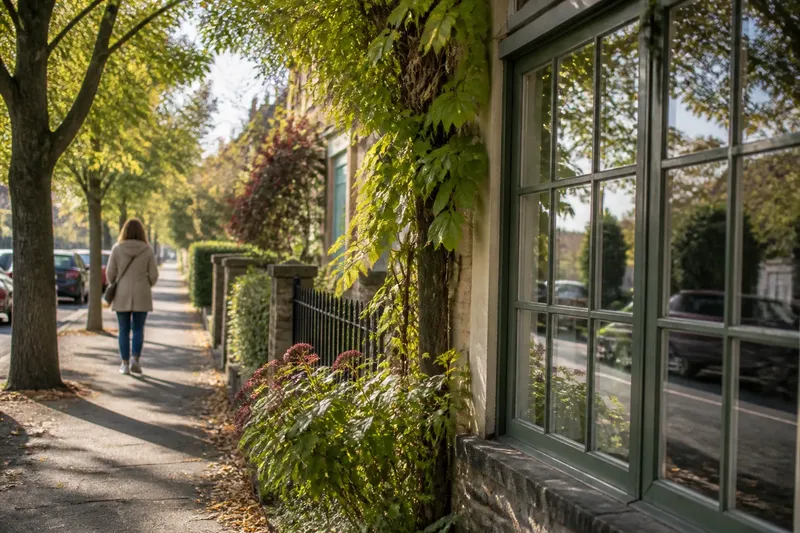
What can make a Sunday walk feel satisfying without turning it into a route to conquer? A slow Sunday walk with one thing to notice starts with a modest choice: pick a visual detail, then let it guide your attention rather than your pace.
Try the shape of leaves, reflections in windows, painted doors, or the way shadows fall across a sidewalk. The point is not to collect examples or cover ground. It is to give your eyes a place to rest while the rest of the walk stays open.
1. Choose a detail that travels
Pick something you could notice in more than one setting. A certain color, repeated curves, small signs of weather, or the edges of plants can all work. A detail with room to vary keeps the walk interesting without requiring a special destination.
Make the choice specific enough to focus your gaze, but not so narrow that you need to find one exact object. “Green” may be too broad; “green surfaces catching light” gives your attention a gentle direction while leaving plenty to notice.
If deciding feels like homework, choose the first visual detail that catches your eye near home. You can change it later if it stops feeling inviting.
2. Pick a route with room
Choose somewhere you already know how to reach: a neighborhood sidewalk, a public garden path, a quiet stretch beside a creek, or a loop through a nearby park. Familiarity can leave more attention for looking around instead of working out where every turn goes.
Let the route have an easy exit or a comfortable place to pause. You might walk to a bench and turn back, follow a path until it naturally bends, or take a short neighborhood loop. The route serves the walk; it does not set a score to beat.
Check the day’s local conditions before setting out, and use ordinary judgment about footwear, visibility, and accessible paths. If weather or the route makes walking uncomfortable, choose another time or place.
3. Leave the pace open
Start at a speed that lets you look without repeatedly stopping yourself from rushing. There is no need to keep a steady rhythm. You might stroll past a row of houses, pause near a patch of sunlight, then continue when you feel ready.
Keep your phone put away if you do not need it for navigation or an urgent reason. A camera can be useful, but it can also turn looking into a hunt for a perfect picture. Try noticing first; take a photo only if it adds to the moment.
Say you choose window reflections on a familiar block. You notice a cloud reflected in a bakery window, then a tree’s branches wavering in a parked car’s glass. The expected result is a walk shaped by small variations, not a need to find a landmark or fill a camera roll.
4. Notice without collecting
As you walk, look for how your chosen detail changes with its surroundings. A shadow may sharpen near a wall and soften beneath a tree. A repeated curve might appear in a gate, a leaf, and the bend of a path. You do not need to count these appearances or remember them all.
When your attention wanders, let it. Notice a bird call, a passing neighbor, or the feel of the air, then return to your visual detail if that still appeals. A single focus is an invitation, not a rule that blocks out the rest of the place.
Stay on public paths and leave plants, stones, and other natural objects where they are. Observation does not need a souvenir.
5. Let pauses belong
A pause can be part of the walk rather than a break from it. Stand where you are not blocking others, sit on a public bench, or wait for a crossing signal while looking at the detail you chose. Give your eyes time to adjust instead of scanning quickly for the next thing.
If the detail is not showing up, do not force it. Shift your gaze to a nearby surface, change your focus to a related feature, or simply enjoy the surroundings without a theme. The walk still counts as time outdoors even when the original idea fades.
Keep any pause comfortable and considerate of other people using the path. A spot that feels calm to you should also leave the route clear.
6. End when it feels done
Choose a natural stopping point rather than waiting for a certain distance or number of sights. It could be your front gate, the end of a familiar path, or the moment your attention starts to feel tired. Turning back early is a sound choice, not a failed outing.
On the way home, you might recall one small contrast: a bright leaf against a fence, or a reflection that changed as you moved. There is no need to write it down unless you want to. The walk can remain a pleasant hour in memory, without becoming another task to maintain.
For a slow Sunday walk with one thing to notice, make the detail easy to find and easy to let go. That small choice can give an ordinary route a fresh quality while leaving the afternoon free to unfold.
Questions about the walk?
What should I notice on a Sunday walk?
Choose a visual feature that appears in several places, such as shadows, repeated curves, or one color in different settings. A flexible subject gives you somewhere to rest your attention without sending you searching for a particular sight.
How long should an unhurried walk be?
Let your available time, comfort, and route guide the outing rather than setting a distance target. A short stroll can feel complete when you have had enough, and you can continue if the walk still feels enjoyable.
Should I take photos of what I notice?
Photos are optional. Look with your own eyes first, then take a picture if you want a memory of a particular detail; you do not need to document every instance.
What if I lose interest in my chosen detail?
Change the focus, let it go, or turn your attention to the place around you. The idea is to make the walk more inviting, not to keep your attention fixed against your wishes.