The Keepsake Box Before the Photo Album
A keepsake box preserves memories through tangible objects and brief notes. Compare it with a photo album, choose a format, and keep each item’s context close.
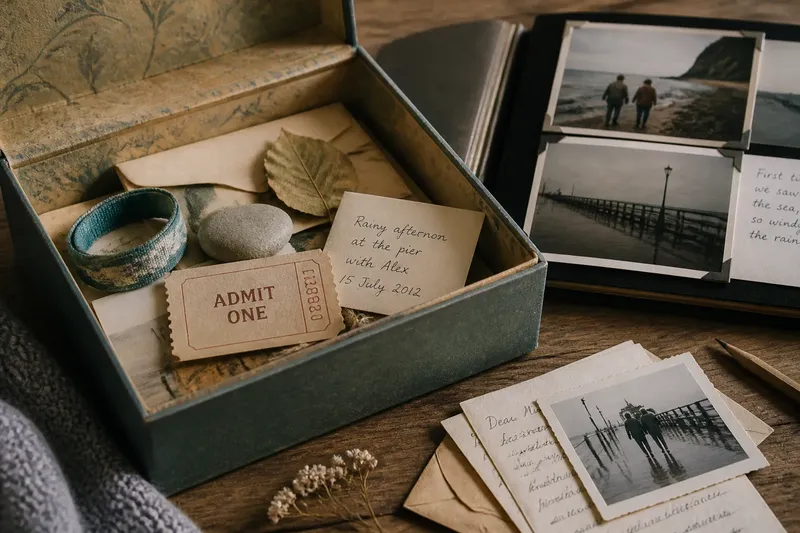
Should you keep that old ticket in a keepsake box or put its story in a photo album? A keepsake box gives tangible objects—paper scraps, notes, and small souvenirs—a place alongside the memories they bring back, while an album arranges pictures into a visible sequence.
Objects as memory cues
A keepsake is an object set aside because it points to an experience, person, or place. A folded program might recall an evening, a pressed leaf a walk, or a handwritten recipe a relative’s kitchen. The object is not a complete record; its value often comes from the memories its owner supplies.
A personal collection can be selective and uneven. It may prompt a memory for its owner without documenting exactly what happened for someone else. A short note can help a future reader understand the connection.
The box and album
A keepsake box gathers physical remnants with varied shapes and textures. An album organizes photographs on pages, making faces, places, and sequences easier to see at a glance.
A box can hold items a photograph cannot preserve directly: a paper wristband, a note on a napkin, or a smooth stone carried home from a shoreline. An album can make the setting and company more legible, especially when photos have captions. Neither format needs to replace the other; a note in an album can point to a related object in a box.
Choose based on how you want to revisit the memory: through tactile assortment, visual sequence, or both.
Three collecting formats
The loose box
A single box suits someone who enjoys browsing without a strict order. It is easy to add a new object, but finding a particular item may take longer if nothing identifies it. Keep heavier objects from pressing on delicate pieces, and use an envelope or suitable sleeve to separate items that could rub against each other.
The dated or themed box
Group objects by a period, person, place, or experience. A labeled envelope inside a larger box can hold travel remnants apart from family letters. Start with broad groups, then divide one only if finding things becomes frustrating.
The box with an album
Pairing objects with photographs suits someone who wants both a tactile reminder and a readable account. Put a short reference in the album or with the object so the two remain connected. Keep the explanation on a separate slip rather than writing on an item that may be fragile.
Choosing a keepsake format?
What belongs in a keepsake box?
Keep an object if it brings back a distinct experience or relationship, such as a handwritten card or a small program. If several items serve the same purpose, choose the one that best prompts the memory and consider letting the rest go.
How can I preserve an object’s meaning?
Write a brief note with the occasion, place, or people it recalls, then store the note beside the object. A plain paper slip or envelope can keep the context close without marking the keepsake.
Should I choose a box or an album?
Choose a box if touch, texture, and mixed objects matter most; choose an album if photographs and sequence matter more. Use both if you want the objects and images to tell different parts of the same memory.
What should I do if the box is crowded?
Sort items by the memories they prompt, then keep the pieces that feel distinct rather than saving several interchangeable reminders. If a bulky object is difficult to store, consider whether a photograph and a note would preserve enough of its story.
A sorting checklist
Use these checks while arranging a small group of keepsakes. Each result points to a practical next choice.
- Check whether the item brings back a specific memory; if it does, keep it, and if not, set it aside for another review.
- Check whether another item prompts the same memory; if they overlap, keep the one with clearer meaning, and if they differ, keep both if space allows.
- Check whether the item’s meaning depends on a person, place, or occasion; if it does, add a separate note, and if it does not, leave it unannotated.
- Check whether the item is delicate or could rub against another object; if so, separate it in a suitable sleeve or envelope, and if not, place it with similar sturdy items.
- Check whether the item is clean and dry before storing it; if it is not, do not close it into the box, and seek material-specific advice if you are unsure how to handle it.
- Check whether the item is fragile or important to your family or finances; if it is, ask a qualified preservation professional for advice, and if it is not, use simple separation and labeling.
- Check whether you can find the item using the current grouping; if not, label an envelope or make a short contents note, and if you can, keep the simpler arrangement.
Labels and context
A keepsake can become hard to interpret when its owner is no longer there to explain it. A compact description can preserve useful context without turning the box into a formal catalog. Include names only when they help identify the memory.
Say you have a folded admission ticket from an outing, a companion’s name, and a memory of a rainy afternoon. Put the ticket in a paper envelope, write the outing and companion’s name on a separate slip, and place the slip in the same envelope. The result is a ticket that can still be handled separately from its note, with enough context to identify the occasion later.
Simple care boundaries
Different materials can need different handling, so treat general storage advice as a starting point rather than a preservation plan. Keep items clean and dry, avoid crowding delicate pieces, and separate objects that might press on or rub against one another. Use a suitable sleeve or enclosure only when you know it is appropriate for that material; otherwise, seek guidance before adding a protective layer.
For an object that is fragile, financially significant, or important to your family, ask a qualified preservation professional about its specific material and condition. A general-purpose box is a place to organize keepsakes, not a substitute for specialized care.
Changing the arrangement
The container does not have to define the collection permanently. Someone who begins with a single box may later add labeled envelopes; an album maker may decide that tickets and handwritten notes need a separate place. Adjust the system when finding or caring for items becomes difficult.
For a keepsake box that remains easy to browse, keep each item’s explanation close and choose a grouping you can maintain. A loose box, a few labeled envelopes, or a box linked to an album can all work—the useful arrangement is the one that lets you revisit the memory without turning the object into a puzzle.