Why a Small Hobby Kit Is Easier to Return To
A small hobby kit keeps materials ready without creating another organizing project, making it easier to restart knitting, watercolor, puzzles, or other pastimes.
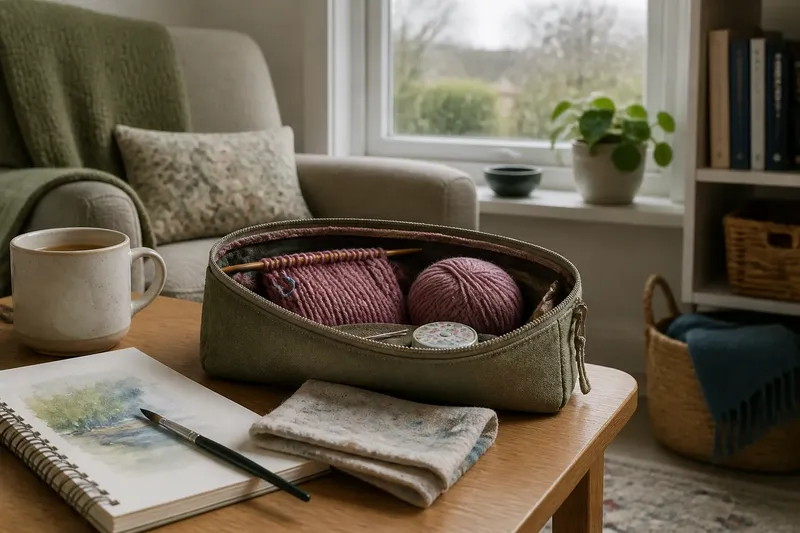
Why does a small hobby kit make it easier to return to a pastime? Because you can begin with a few useful materials already together instead of first searching, sorting, and deciding what belongs. A modest kit turns the first move into opening a pouch or box, not preparing for an entire hobby session.
What belongs in a small hobby kit?
Keep the materials needed for one ordinary starting task, not every tool you might ever use. For knitting, that could mean one current project, its yarn, the right needles, and a yarn needle. For watercolor, it might be a small pad, a few paints, a brush, and a water cup.
Choose items that work together and match the way you actually practice. A puzzle kit might hold the puzzle in progress and a sorting tray; a mending kit might hold the garment, thread, and needles for its next repair. Extras belong elsewhere until a particular task calls for them.
Use a container that opens easily and fits the materials without forcing them into a tight arrangement. A pencil case, shallow basket, reusable zip pouch, or small lidded box can all work. The right container is the one you can put away and retrieve without rearranging a shelf.
- Include the tool needed to start, not a full tool collection.
- Keep the current project or a clear next task with its supplies.
- Add small accessories that are easy to lose, such as a stitch marker or pencil sharpener.
- Leave out materials that require special storage or are unrelated to the next session.
- Check that the kit closes or stores safely without crushing or tangling its contents.
For materials with specific storage or handling requirements, follow the product label, manufacturer instructions, or relevant local rules.
How small should the kit be?
Make it small enough that putting it away feels routine, but complete enough that starting does not require a supply hunt. Its size depends on the pastime and the place where you keep it; there is no useful universal container size. A kit for hand stitching may fit in a pouch, while a board game or a larger craft may need a basket.
A simple test is to imagine the first few minutes of a normal session. If you can retrieve the kit, see the next task, and begin without fetching several unrelated items, it is likely compact enough. If you routinely need to assemble a second pile before starting, add only the missing essentials or change the container.
Say you want to return to watercolor after a busy week. Imagine keeping a small pad, a limited palette, one brush, and a cloth in a basket near your usual chair; when you have a little free time, you can set out water and paint a wash. The expected observable result is that the materials are ready for that modest task, without first unpacking a larger collection.
Where should the kit live?
Choose a spot you naturally pass or use, rather than the most attractive storage location. A shelf beside your reading chair, a drawer near the dining table, or a hook by the door can work if the kit remains easy to reach and does not obstruct household use.
Think about what happens between sessions. If a project needs a clear table, choose a container that can be moved in one trip. If the hobby is portable, store it near the bag or coat you take along. The goal is not to display supplies; it is to make retrieval feel like a small, ordinary action.
Keep the kit visible enough to remember, but not so exposed that it becomes clutter or gets disturbed. A clear pouch inside a drawer can offer a middle ground: the project is easy to spot when you open the drawer, while the surface stays clear.
How do you keep it ready?
After a session, restore only the pieces needed to continue. Put the tool back, secure loose materials, and leave the project at a clear stopping point. A note such as “continue with the blue section” can help if the next move will not be obvious later.
Do not make a full inventory after every use. A quick glance is enough to notice that the thread is nearly gone or the brush needs attention. Replace a missing essential when it becomes relevant, rather than shopping for hypothetical future projects.
When the current project ends, decide whether the kit should hold another small task or be cleared. That choice prevents old materials from accumulating simply because they once fit. Keep the container; let its contents change with your actual interest.
What if the hobby needs more supplies?
Separate the active kit from the broader supply collection. The kit holds what is needed to resume the current pastime; a cabinet, shelf, or other storage area can hold specialist tools and materials for less frequent tasks. This keeps the starting point light without requiring you to discard useful equipment.
If a task genuinely needs several pieces, group just that task’s materials together. For example, a sewing project involving a particular fabric may need matching thread, pins, and a suitable pair of scissors. Keep the bundle manageable and return unused general supplies to their usual place.
When setup involves shared space, plan for a compact reset: know where the kit goes and what must be put away before the area is used for something else. That makes the hobby easier to fit into a household routine without treating every session as a special event.
Why does restarting feel difficult?
Often, the obstacle is not a lack of interest but a cluster of small decisions: where the materials are, what to do first, and whether anything is missing. A ready kit cannot supply motivation on demand, but it can remove some of those preliminary choices.
Make the first task deliberately modest. Instead of “work on the whole project,” choose “cast on the next row,” “sort a handful of pieces,” or “mix one color.” A visible next action gives you a place to begin without demanding that you commit to a long session.
If you return and discover that the kit no longer suits the way you practice, adjust it after the session. Perhaps the container is awkward, or the materials need a different place. Make one practical change, then leave the rest of the setup alone.
Can the kit change with your routine?
Yes. A hobby kit is a working arrangement, not a permanent system. If you start taking a pastime to a class, add only what the class requires; if you mostly use it at home, remove portable extras that take up room without helping you start.
Revisit the contents when the next project changes or when you notice a repeated delay. Ask what you actually reach for first, what you keep moving aside, and what you have to search for. Those observations are enough to guide a small edit; there is no need to reorganize every hobby supply.
The useful measure is whether returning to the pastime feels approachable. A small hobby kit works best when it holds the next invitation to begin: a project, a few fitting materials, and a clear first action. Keep that invitation easy to see and easy to put away, and let the rest of the collection stay in reserve.