Sketchbook or Loose Sheets for Casual Drawing?
Sketchbook or loose sheets for casual drawing? Choose a format that suits where you draw, how you like to revisit pages, and what you use to make marks.
Sketchbook or loose sheets for casual drawing? Start with the place you tend to draw and the way you want a finished page to feel. A bound book keeps marks together and gives a session a next page; separate sheets let you spread out, rearrange work, or keep a drawing apart from the rest.
Neither format makes a casual habit more serious or more worthwhile. The useful choice is the one that removes a small annoyance from your usual routine. To make it, picture an ordinary drawing session, consider your materials, then decide how much connection you want between one page and the next.
Start with your setting
Think about where drawing usually fits: at a kitchen table, on a train, in a waiting room, or beside a window. A sketchbook is a self-contained surface. Its cover protects the pages, and the binding gives you something to hold while you draw away from a desk.
Loose sheets suit a stable surface where you can put a page flat. You can turn the paper to follow your hand, move a drawing aside, or keep several studies visible at once. Those freedoms matter less if you usually draw on your lap or need to pack away quickly.
Also consider what happens between sessions. A book slips into a bag as one object. Loose paper needs a folder, envelope, or portfolio if you want to keep edges from bending or marks from rubbing onto other belongings.
Choose for the setting you actually use, not an imagined studio. If you draw in several places, note which one is hardest to accommodate; let that awkward setting guide the format.
Match paper to marks
Before choosing a book or a stack, identify the tools you reach for most. Graphite, colored pencil, pen, marker, and wet media behave differently on paper. A format is only convenient if its pages work with your marks.
Check the paper description and, where possible, handle a sample. Look for a surface that suits your drawing tool: smoother paper can feel comfortable for fine pen lines, while a more textured surface may give pencil marks a different character. If you use ink or water-based media, check whether the paper is intended for that kind of use.
Bound books may have paper that varies in thickness and texture, and the binding can affect how easily a page lies flat. With loose sheets, you can choose among individual paper types and sizes, but that freedom can turn into a decision each time you replenish your supply.
For a casual routine, consistency can be useful. If you like knowing how a pencil will move from one session to another, select a book or paper stock and keep using it. If you enjoy changing materials, loose sheets make it easier to set aside a surface for a particular tool.
Choose your kind of freedom
A sketchbook offers continuity. The pages stay in order, so a page of rough shapes can sit beside a drawing made later, without asking you to sort or file anything. That sequence can make it pleasant to return to an unfinished thought or browse without deciding what deserves to be kept.
The same sequence can feel restrictive. You may dislike leaving a page blank, drawing over a page you consider finished, or having an early scribble bound beside later work. You can ignore those concerns, but if they regularly stop you from opening the book, the binding is not helping.
Loose sheets offer freedom of arrangement. Keep a drawing visible while you work on another, group related sketches, or separate a page when you want to share or store it. The tradeoff is that you must choose what to do with sheets after drawing: leave them in a pile, file them, or let some go.
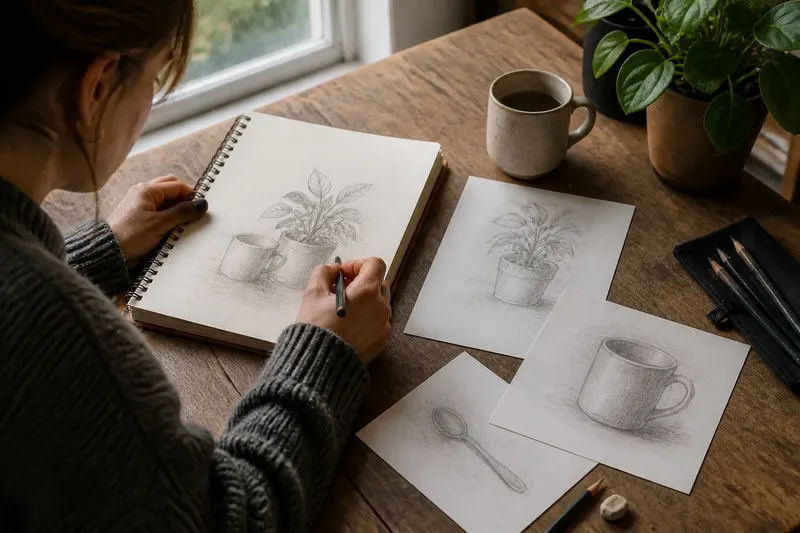
Imagine you draw a few cups and leaves at the kitchen table, then want to compare their shapes the next day. In a sketchbook, the pages are already together; with loose sheets, you can place the drawings side by side. In either case, the expected observable result is that the comparison is easy to make, but the convenient format depends on whether you prefer sequence or rearrangement.
Sketchbook or loose sheets?
Which is easier to carry?
A sketchbook is usually simpler to carry as a single protected item. Loose sheets can travel well in a stiff folder, but they need that extra container and space to stay flat.
Which is better for drawing at a table?
Loose sheets are easy to rotate, spread out, and move aside on a clear table. A sketchbook can work just as well if its binding opens comfortably and you do not need multiple pages visible at once.
Can I use both formats?
Yes. You might keep a sketchbook for drawing away from home and use loose sheets for larger work or studies that need rearranging. A mixed approach is useful when each format has a clear job rather than becoming two competing supplies.
What if I dislike keeping every drawing?
Loose sheets make it straightforward to keep selected pages and recycle the rest. A sketchbook can still work if you are comfortable with unfinished or unwanted drawings remaining among its pages.
Try a small comparison
If the choice still feels abstract, compare the formats using the same ordinary subject and tools. Draw something already nearby, such as a spoon, a plant pot, or a pair of shoes. The point is not to judge the drawings; notice whether the paper, support, and handling let you settle into the activity.
- Pick a subject you can see from where you usually draw.
- Use the drawing tool you reach for most often.
- Make one quick sketch in a sketchbook, without worrying about the next page.
- Make another on loose paper, and turn or reposition the sheet if you want.
- Notice which setup made it easier to begin and continue.
- Decide how you would store or carry each drawing after the session.
Keep the comparison casual. If the paper types differ, the result may reflect the paper as much as the format, so use the same kind of paper where practical. Follow the product instructions for any specialty media or paper that has specific handling requirements.
Pay attention to friction rather than polish. Did the book resist lying open? Did the loose sheet slide around? Did you want a clean page for the next drawing, or did seeing the previous one help you carry on? A minor inconvenience that repeats in your normal setting is more useful evidence than a dramatic difference in one session.
Make storage part of it
Decide what happens to a drawing before you choose a format. If you like browsing old pages, a sketchbook stores the work in a compact sequence. If you want to pin up, share, or sort individual drawings, loose sheets make access easier.
Loose work does not need an elaborate filing system. A labeled folder can separate drawings you want to keep from paper you are still using. If you prefer not to archive casual sketches, leave a small recycling spot near your drawing place and clear it when it becomes inconvenient.
For a sketchbook, choose a place where it is easy to reach and where the cover protects the pages from everyday clutter. You do not need to treat every mark as a record. A book can hold experiments, notes, and pages you would not display.
Storage should preserve the kind of drawing you enjoy, not turn drawing into paperwork. If sorting loose sheets feels like an unwanted chore, favor a book; if bound pages make you feel obliged to keep everything, favor separate paper.
Settle on a format
Choose a sketchbook if you value a portable, protected object, like seeing pages in sequence, or want drawing to require little setup. Choose loose sheets if you value a flat surface, changing page orientation, comparing drawings side by side, or keeping only selected work.
If both descriptions fit, give each format one role. For example, use a small sketchbook for quick drawings while away from home and loose sheets at a desk when you want room to move the page. Keep the distinction simple enough that you do not have to decide from scratch each time.
Then make the next session easy to start: put the chosen paper where you tend to draw, set out a familiar pencil or pen, and choose an ordinary subject. After a few casual sessions, ask whether the format helped you begin, continue, and put the drawing away in a way that suits you. The right answer is the one that makes casual drawing feel easy to return to, not the one that looks most impressive on a shelf.